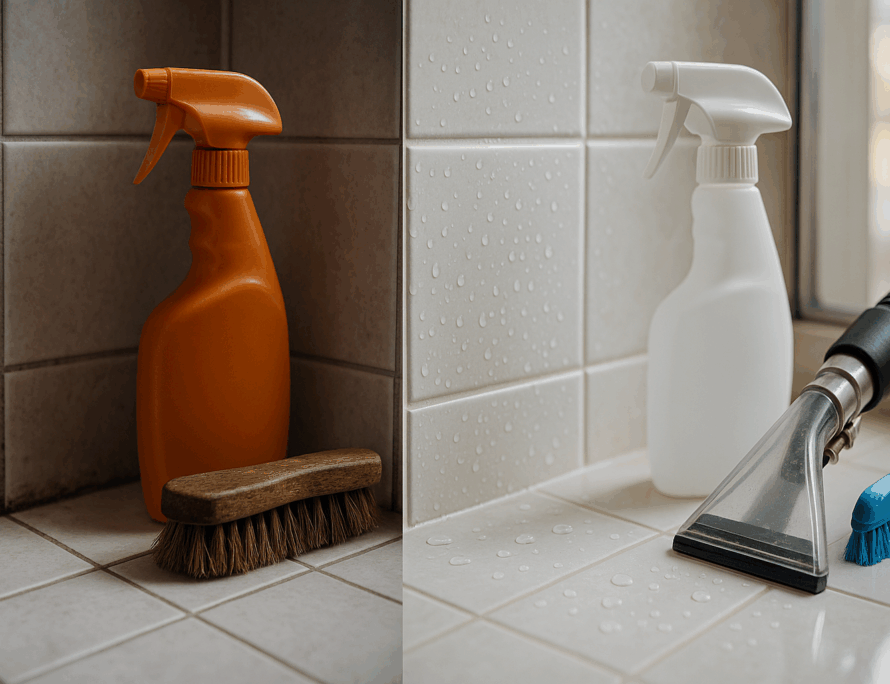
You just paid to get your tile and grout sealed, and the fastest way to waste that money is sitting under your sink. Bleach, vinegar, ammonia, and steam mops all strip the sealer, so the stains come right back and you are resealing years too early. The fix is boring, and it works: a pH-neutral cleaner and a soft touch.
I am Mike Voss, co-owner of Bathroom Bidders. Most of the “my grout looks dirty again” calls I get across Kansas City are not dirty grout at all. They are a stripped seal, usually from whatever smelled clean under the sink. Here is exactly how to clean sealed tile and grout so the seal actually lasts, the same routine I leave with every clean and seal customer in Overland Park, Olathe, and the metro before I pack up.
The Number One Reason Grout “Looks Dirty Again”
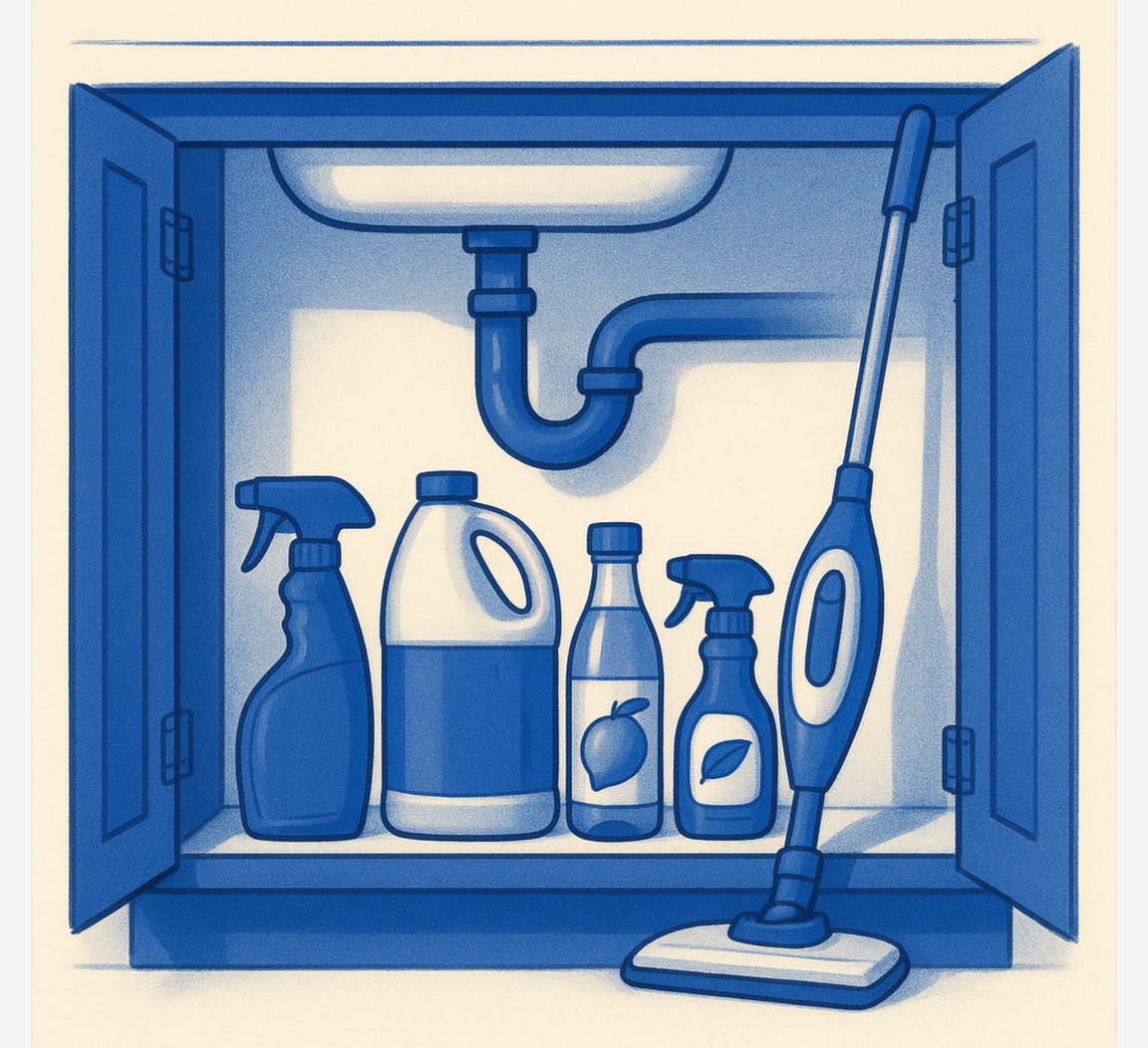
The whole fix is in that photo. The cheapest bottle under the sink, a pH-neutral cleaner for about $12, is the one that protects the $500 or more you spent getting the tile and grout sealed. The bleach, the vinegar, the citrus spray, and the steam mop are the ones quietly undoing it. Reach for the wrong one every week and you are paying to reseal years early.
Here is what I actually see in the field, and it is by far the most common clean and seal call I get in Kansas City. A homeowner scrubs and scrubs, and the grout still looks dirty. Almost every time, it is not dirt. The grout was never sealed, or the sealer wore off, so the lines are wide open and soaking up soap, minerals, and grime faster than anyone can scrub it back out.
Grout is porous, like a hard sponge. Sealer is the thin barrier that keeps water and stains sitting on top of it instead of soaking in. The moment that barrier is gone, dirt gets into the grout, and no cleaner on earth can reach it from the surface. That is why scrubbing harder feels useless: you are polishing the top of a sponge that is already stained on the inside. The second thing I see is people speeding that failure up with the wrong cleaner. A weekly wipe with vinegar or a citrus spray feels like good maintenance, but both are acidic enough to strip whatever seal is left. It is almost always an honest mistake, because nobody tells you the cleaner is the problem.
So before you go buy a stronger cleaner, figure out which problem you actually have: a dirt problem, or a seal problem. Scrubbing fixes the first and makes the second worse. The rest of this guide shows you how to clean sealed grout so it stays sealed, and how to tell when the seal is already gone.
The Safe Routine for Cleaning Sealed Tile and Grout
Cleaning sealed grout is less about scrubbing hard and more about not undoing the sealer you paid for. Here is the whole routine, start to finish. Most bathroom floors take about 30 to 60 minutes.
- Sweep or vacuum first. Get the grit up before any water touches the floor. Wet grit is sandpaper on your grout lines.
- Mop with a pH-neutral cleaner, mixed to the label. Neutral pH cleans about as gently as water and leaves the seal alone. Acidic and alkaline cleaners eat it.
- Work the grout lines with a soft nylon brush, and go over the tile face too. With a pH-neutral cleaner it is safe to clean every inch, and the tile itself picks up its own film from hairspray, soap, and hard water, so cleaning the whole surface is what leaves the bathroom looking uniform. On a stubborn line, let the cleaner dwell for a minute or two first so it does the work, rather than scrubbing hard on dry grout. Just skip stiff and wire brushes, which scratch the seal right off.
- Rinse and change the water often. Dirty mop water just smears soil back into the grout instead of lifting it.
- Dry the floor when you are done. Standing water settles into the low spots and darkens the grout over time.
That is it. No foaming miracle spray, no heat, no acid. Boring on purpose, because boring is what makes a seal last. Per the Tile Council of North America (TCNA), routine care of sealed tile and grout should use a neutral cleaner and thorough rinsing, and grout should be resealed on a schedule as the sealer wears.
What to Do About a Stubborn Stain
Sometimes one spot will not lift with the normal routine. Before you reach for anything harsh, try the gentle fix: make a paste of baking soda and water, spread it on the stain, give it a few minutes, then work it with a soft nylon brush and rinse. For a mildew spot, a little diluted hydrogen peroxide on the line does the same job. Spot-test either one in an out-of-the-way corner first, because both are stronger than your everyday cleaner.
Two hard rules on tough stains. First, keep chlorine bleach and oxygen bleach off colored or color-sealed grout; they can lighten the color and leave you with a pale blotch instead of a stain. Second, if a spot will not come up with a gentle paste, that is usually the tell that the seal is already gone and the grout has soaked the stain in, so the real fix is a clean and reseal, not a harder scrub. The water-drop test further down confirms it.
If a stubborn stain will not respond to a gentle cleaning paste, stop experimenting with stronger chemicals. That is the point where the wrong cleaner does the real damage: it can permanently discolor grout, etch natural stone, or dull certain tile finishes. You are no longer removing a stain at that point, you are creating a second problem on top of it.
This is the point to bring in a tile and grout restoration specialist. An experienced technician can identify what your tile and grout actually are, then match the safest effective chemical to that specific stain instead of guessing. Depending on the condition of the grout, the fix is usually one of three:
- Professional stain removal using cleaning agents chosen for your tile material.
- Color sealing, which restores a uniform color and protects the grout from staining again.
- Grout removal and replacement if the stain is permanent or the grout has deteriorated past saving.
Knowing when to stop cleaning is what keeps a minor cosmetic issue from turning into an expensive repair. If you have already tried the gentle paste and the spot is still there, that is your answer: it is a sealing problem, not a scrubbing problem. Mike will look at it and tell you which of the three it is, at no charge.
Why Vinegar, Bleach, and Steam Wreck Your Seal
Sealer is a thin barrier that makes porous grout shrug off water and stains. Acids and harsh alkalines dissolve that barrier a little every single time you clean with them. Here is where the common bottles land, and what each one does.
- Neutral pH (about 7) cleans about as gently as water and lifts stains without weakening the seal. Sealer manufacturers recommend a pH-neutral cleaner for routine care specifically because it will not break the seal down early.
- Vinegar and citrus (acidic, around pH 2 to 3) open grout pores, dissolve the cement in grout, and break down water-based sealers. Even cleaning-vinegar makers warn against using it on grout and natural stone.
- Bleach and ammonia (alkaline, around pH 11 to 13) are caustic. Used over and over they erode grout and strip the protective sealer, and the fumes are no joke in a small bathroom.
- Steam mops drive heat and pressure into the joint. This is why Mike does not recommend steam cleaning a sealed floor: used regularly, the heat shortens the sealer’s life compared with simple neutral-cleaner mopping.
Not every surface handles the same cleaner. Here is what is safe, what to spot-test, and what to keep away from your grout for good, by surface type.
| Surface | Safe for everyday use | Use with caution (spot-test first) | Avoid entirely |
|---|---|---|---|
| Sealed ceramic / porcelain | pH-neutral floor cleaner, a little dish soap in water | Diluted hydrogen peroxide, baking-soda paste on a stain | Full-strength bleach, strong acids, daily steam |
| Sealed natural stone (marble, travertine, limestone) | Stone-safe pH-neutral cleaner only | Very dilute peroxide, and only if the stone’s maker allows it | Vinegar, lemon, any acid, and “natural” citrus sprays (they etch stone) |
| Epoxy grout | Mild alkaline cleaner or the grout maker’s own cleaner | Steam (check the maker first) | Solvents that can soften the resin |
The infographic below lays out the whole thing at a glance: the bottles under a normal sink, where each lands on the pH scale, what the sealer actually does at the material level, and what reaching for the wrong bottle really costs. Save or pin it for later.

Is Your Grout Still Sealed? Take the 60-Second Self-Test
Not sure whether your seal is still doing its job? Run the same five checks I use on a Kansas City assessment. Your answers add up to a straight recommendation.
How to Tell If Your Seal Is Already Gone

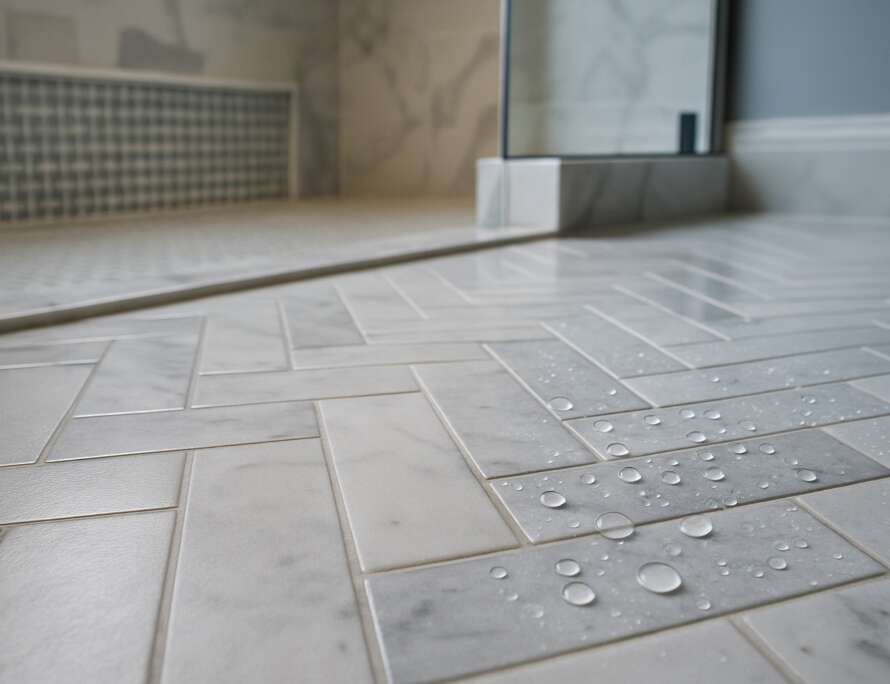
The water-drop test takes ten seconds, and I run it on every job, but the timing matters: do it on grout that is clean, rinsed, and fully dry. Clean the area first, rinse it, and let it dry all the way, then sprinkle a little water on a grout line and watch it. If the grout is still damp or still dirty, you may not see any color change and you will misread the result, so let it dry before you judge. On clean, dry grout, if the water beads up and sits there, your seal is working, so keep doing exactly what you are doing. If it soaks in and the line goes dark, the sealer is worn off, and no amount of scrubbing will fix that. That grout needs a clean and a fresh seal.
If it is soaking in, cleaning harder is a waste of a Saturday. For how long a fresh seal should last before you re-run this test, see our guide on how often to reseal grout. In a Kansas City shower, plan on every 1 to 2 years; our hard water and long humid summers are harder on grout than a drier climate, so mineral film and mildew build faster here.
Can Steam Cleaning Damage Tile and Grout?
The self-test above matters most right here. Earlier we covered what steam does to a sealed floor, where the cost is a shorter sealer life. This is the other case, and it is the expensive one: what steam does to an older floor whose seal is already gone.
Most homeowners assume steam is one of the safest ways to clean any hard surface. It works well on some floors. Older tile with worn or cracked grout is a different situation entirely.
Picture Joe and Jill, first-time buyers who just closed on a 15-year-old house. One of the things that sold them was the open kitchen with its ceramic tile floor. They want everything spotless before they move in, so they book a professional steam cleaning, because they have seen hardwood done that way.
What they do not know is that tile and grout behave nothing like hardwood.
Grout is a cement-based material filling the joints between tiles. Its job is to limit moisture getting into the installation and to support the tile edges. Under the tile is a mortar bed, and that layer is designed to bond the tile to the substrate, not to survive repeated soaking.
If the grout was never sealed, is cracked, or has sections missing, steam goes straight through those weak spots. This is not the same as a damp mop on the surface. Heated moisture is driven under pressure into hairline cracks, pinholes, and failing joints.
Once water is inside the installation, a few things can follow:
- Moisture gets trapped underneath the tile with no easy way out.
- Repeated exposure breaks down grout and mortar over time.
- Tiles that were already loose start to announce themselves as the area around them weakens.
- Dissolved mineral salts travel to the surface and dry as a white, chalky film called efflorescence.
Efflorescence happens when water moves through cement-based material, dissolves the salts naturally in it, and leaves them on top as it evaporates. The white residue itself usually cleans off. What it is telling you is the part that matters: water is moving through your tile system.
Give it time and you start to see grout crumbling at the joints, tiles that sound hollow underfoot, and spots that flex a little when you step on them. In most of these cases steam did not create the problem. It accelerated one that was already there from age, moisture, or grout that had quietly failed years earlier.
This is especially common in older floors that were never sealed or maintained, which in Kansas City covers a lot of houses.
If your tile is aging, the safe routine is the boring one: a pH-neutral cleaner and grout sealed on a schedule. If the grout is cracked, missing, or clearly failing, repair it before you introduce a lot of moisture. Fixing the joint first is cheaper than replacing the floor later. If you are not sure how far along yours is, here are 7 signs moisture is already behind the tile.
Steam is not automatically harmful to every tile floor. On an older installation with compromised grout, it can turn a maintenance job into a repair bill. When you are not sure which one you have, have the grout looked at before you point a steamer at it.
Cleaning Sealed Grout in a Restaurant or Rental
Property managers and restaurant owners hit the same wall as homeowners, just faster. High-traffic tile gets mopped daily, often with whatever industrial degreaser is on the shelf, and those are usually alkaline enough to strip a seal in weeks. Once it goes, the grout stains, holds odor, and fails a health inspection’s “clean and sanitary surface” line. For commercial and multi-unit work we schedule the clean and seal off-hours or on weekends so you stay open, and we set you up with a neutral-cleaner routine your staff can actually follow. A sealed, maintained floor stays easier to keep sanitary and lasts years longer between restorations.
The Golden Rule
Neutral pH, always. Never vinegar, never bleach, never a steam mop. If you remember one thing from this whole guide, make it that sentence. It is the difference between a sealed bathroom that still looks new in a few years and one that is back to looking dirty in a few months.
Here is why it holds up. A sealer is a thin barrier, and only two things break it down: chemistry (acids and harsh alkalines) and heat (steam). A neutral cleaner has neither, so it lifts everyday soap and grime while leaving that barrier completely alone. Checking a bottle is easy. The label will say “pH-neutral” or “safe for sealed stone and grout.” If instead it brags about cutting through grime with acid, bleach, or ammonia, put it back on the shelf. That power is aimed straight at your sealer.
Everything else really is just details stacked on that one rule. Sweep before you mop so grit cannot scratch the lines. Work the grout with a soft brush, and clean the whole surface, grout lines and tile face alike, since a neutral cleaner is safe on every inch. Change the rinse water before it turns gray and starts smearing dirt back in. Dry the floor so water does not sit in the low spots. Do those small things and a professional seal can last its full one to two years in a Kansas City bathroom instead of burning out early, which is really what this comes down to: protecting the money you already spent getting it sealed.
Free Download: The Sealed Grout Care Checklist
Want the routine and the “never use these” list on one printable page you can tape inside a cabinet? Download the free Grout Life & Reseal Checklist (PDF). No email required.
Straight Answers
Can I use vinegar on sealed grout?
No. Vinegar is acidic and breaks down the sealer, and it etches natural stone like marble and travertine. Use a pH-neutral cleaner instead. The same goes for citrus and lemon sprays, “natural” does not mean safe for a seal.
What is the best everyday cleaner for sealed tile and grout?
A pH-neutral floor cleaner with a microfiber mop, changing the water often. Skip vinegar, bleach, ammonia, and steam mops entirely. A little dish soap in water works in a pinch but can leave a film that dulls the finish.
How often should grout be resealed in a Kansas City bathroom?
In a wet area like a shower, every 1 to 2 years. KC’s hard water and humidity push it toward the shorter end. The 10-second water-bead test tells you for sure: when water soaks in instead of beading, it is time to reseal.
Does cleaning remove mold from grout?
Surface mildew, yes. If mold has set deep into unsealed grout, cleaning will not reach it and the grout may need to be replaced, which is exactly why keeping the seal intact matters.
Can you clean and seal a Kansas City restaurant without closing us down?
Yes. For commercial and multi-unit work we schedule off-hours and weekends so you stay open. Sealed commercial grout resists staining and stays easier to keep sanitary between deep cleans.
Can I use bleach on sealed grout?
Not for routine cleaning. Bleach is alkaline and caustic, and used over and over it erodes the grout and strips the sealer, so the stains come back faster. The fumes are also no joke in a small bathroom. Keep a pH-neutral cleaner for everyday work and the seal lasts.
Can you steam clean sealed grout?
No, Mike Voss does not recommend it. Steam drives heat and pressure straight into the grout joint, and used regularly it breaks the sealer down early. A pH-neutral cleaner and a microfiber mop are all a sealed floor needs, so keep the steam mop off the tile.
Why does my sealed grout still get dirty?
Usually the sealer has worn off, so the porous grout is soaking up soap, minerals, and grime again. Scrubbing harder will not fix it because the dirt is inside the grout. Run the 10-second water-drop test on clean, dry grout: if water soaks in instead of beading, it is time to clean and reseal, not scrub.
How do I know if my grout is sealed?
Clean and dry the grout line first, then sprinkle a few drops of water on it and watch. If it beads up and sits on top, the seal is working. If it soaks in and the line goes dark, the sealer is gone and that grout needs a fresh seal. Test it wet or dirty and you may miss the color change, so let it dry first.
Can I use a Magic Eraser or an abrasive pad on sealed grout?
Sparingly, and gently. A melamine sponge like a Magic Eraser is mildly abrasive, so it is fine to touch up a spot on the tile face, but scrubbing it hard along a grout line burnishes and thins the sealer over time. For grout, a soft nylon brush and a pH-neutral cleaner do the job without wearing the seal. Keep steel wool and stiff scouring pads off sealed grout entirely.
Should I reseal grout after a deep cleaning, and how long do I wait?
Only if it needs it. Run the water-drop test once the grout is clean and fully dry; if water still beads, the seal is intact and you are done. If it soaks in, reseal, but let the grout dry completely first, usually about 24 hours, since sealer will not bond to damp grout. In a Kansas City shower, plan on resealing every 1 to 2 years.
Ready for a Fresh Start?
If your grout is already soaking up water, cleaning it harder will not bring it back, the seal is gone. A professional clean and seal makes it look new and protects it for years, from $350. Bathroom Bidders is veteran-owned and serves Kansas City, Overland Park, Olathe, Lee’s Summit, and the metro.
Related Reading
- How Often Should You Reseal Grout?
- Top Mistakes in Grout Maintenance
- DIY vs. Professional Grout Cleaning
- Does Your Tile Need Replacing, or Just a Clean and Seal?
- Our Grout Cleaning & Sealing service and the Cleaning & Sealing hub.
- Care and reseal guidance from the Tile Council of North America.
Put one drop of water on the grout. If it beads you are fine. If it soaks in and darkens, the sealer is gone. Our 11 point audit walks the rest of the house in about two minutes and gives you a straight answer on whether it is a clean and seal or a repair.
Take the free 2 minute audit